FIP means female iron pipe: a fitting with threads cut inside the opening, so a male-threaded part screws into it. Stand in the fittings aisle for five minutes and you will see those three letters stamped on valves, elbows and adapters, and picking the wrong one is the single most common reason homeowners make a second trip to the store. Here is how the threads work, what the sizes really measure, and how to make the joint hold.
What Does FIP Mean in Plumbing?
FIP stands for female iron pipe.
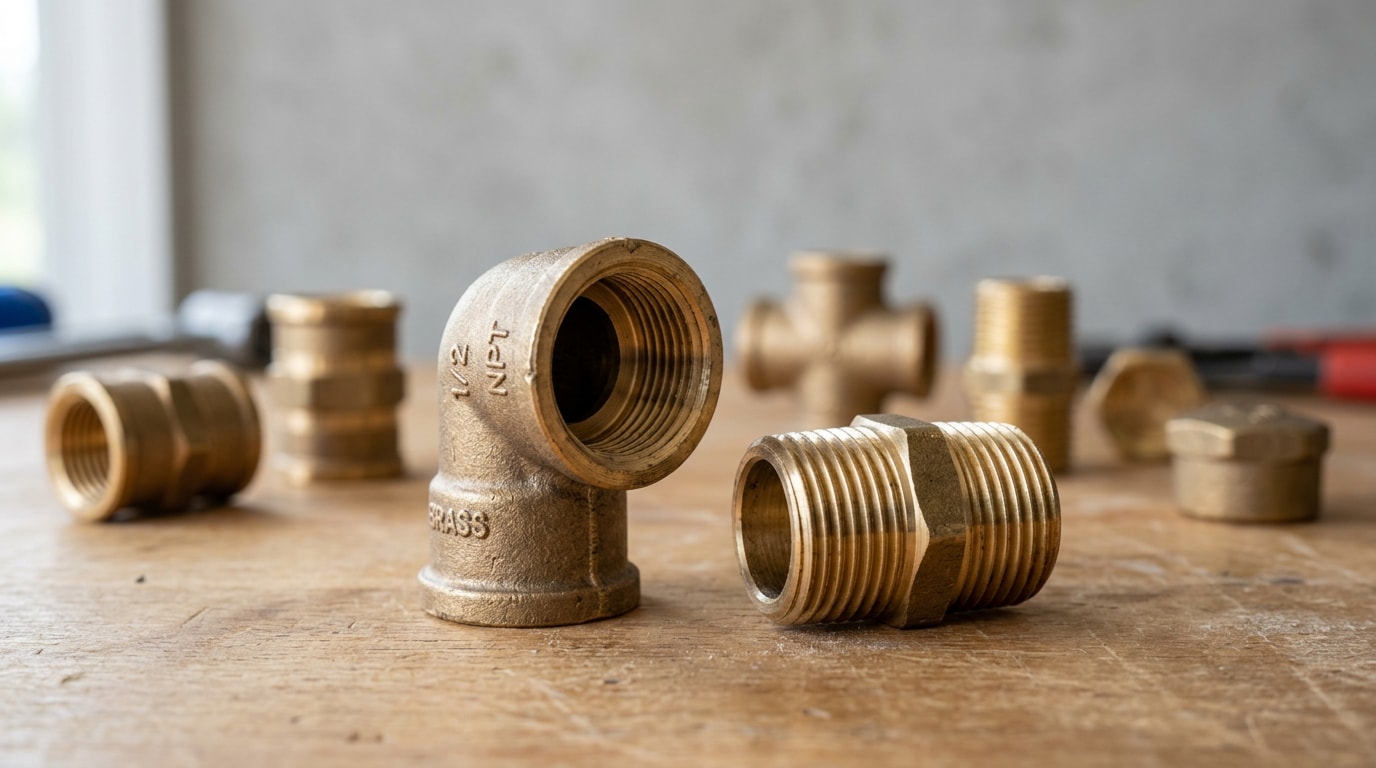
It describes a fitting with threads on the inside of the opening, so it receives a male-threaded pipe or fitting that screws into it.
The "iron pipe" half refers to the sizing convention, not the metal the part is made from.
That last point trips people up. Iron Pipe Size (IPS) is simply the dimensional system the threads follow, which is why you will find FIP threads on brass valves, PVC and CPVC fittings, stainless couplings, copper adapters and PEX transition fittings. Almost none of them contain iron.
You will also see the same female end labeled FPT (female pipe thread), FIPT or FNPT on packaging and spec sheets. Treat those as interchangeable for standard residential work.
If it helps, think of a nut and a bolt: the FIP fitting is the nut, and the male fitting threading into it is the bolt.
FIP vs. MIP: What Is the Difference?
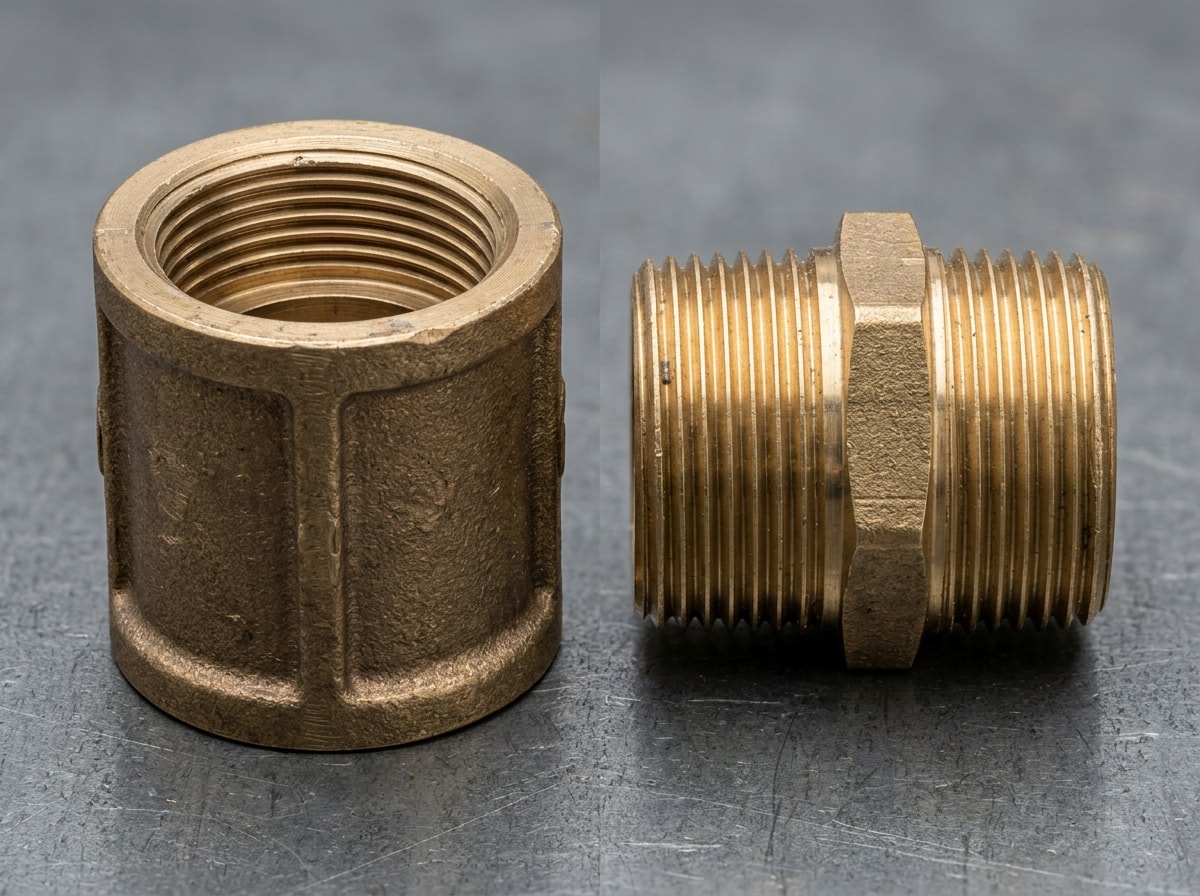
One rule covers it: FIP receives, MIP inserts. MIP means male iron pipe, and its threads sit on the outside of the part.
| FIP (female) | MIP (male) | |
|---|---|---|
| Thread location | Inside the opening | Outside the end |
| Mates with | A male fitting | A female fitting |
| Sealant goes | Not here | On these threads |
| Typical examples | Angle stops, couplings, drop-ear elbows, hose bibb bodies | Water heater nipples, pipe nipples, appliance connector ends |
Just as FIP appears as FPT or FNPT, the male half shows up as MPT or MNPT. Same part, different label.
Two things must line up for any threaded connection to work: the nominal sizes have to match, and the thread gender has to be opposite.
Two FIP fittings will never join directly. You need a nipple or a male adapter between them.
Is FIP the Same as NPT?
Effectively yes. The three terms answer three different questions about the same part.
- NPT (national pipe taper) tells you the thread geometry.
- FIP or MIP tells you which end you are holding.
- IPS tells you the size family.
So a 1/2" FIP fitting accepts a 1/2" male NPT fitting. If a spec sheet says NPT and the shelf tag says FIP, you are looking at the same thread standard, and FNPT is just the more precise way of writing it.
The profile itself is defined in ASME B1.20.1, the standard that covers dimensions and gaging of the most common pipe threads, including NPT, NPSC, NPTR, NPSM and NPSL . You can review the ASME B1.20.1 pipe thread standard listing for the full dimensional detail.
Two labels worth knowing: NPTF is a dry-seal variant with tighter tolerances, and NPS is the straight-thread cousin that does not taper.
Do not assume British BSPT/BSPP or metric threads will mate with NPT. The angles and pitches differ, and forcing them ruins both parts.
What Are Pipe Threads, Exactly?
Threads are the continuous spiral ridge cut or molded onto a pipe end. Each ridge has a crest (the outer peak), a root (the valley between ridges) and two angled flanks connecting them.
When two parts thread together, a fine spiral gap remains between crest and root. Filling that gap is exactly what thread sealant does.
Pipe threads come in two geometries:
- Tapered threads get slightly narrower along their length, so the joint wedges tighter as you turn it.
- Straight threads keep one diameter and rely on a washer or O-ring to seal.
Nearly every threaded fitting in a North American water or gas line uses the tapered style.
FIP Sizes and How to Measure Thread Size
Residential FIP sizes run 1/4", 3/8", 1/2", 3/4" and 1". In practice, 1/2" and 3/4" cover most household supply work.
Now the trap that causes most returns: nominal pipe size is not a measurement. The number is a legacy label tied to the old inside diameter of iron pipe, so a tape measure will mislead you every time.
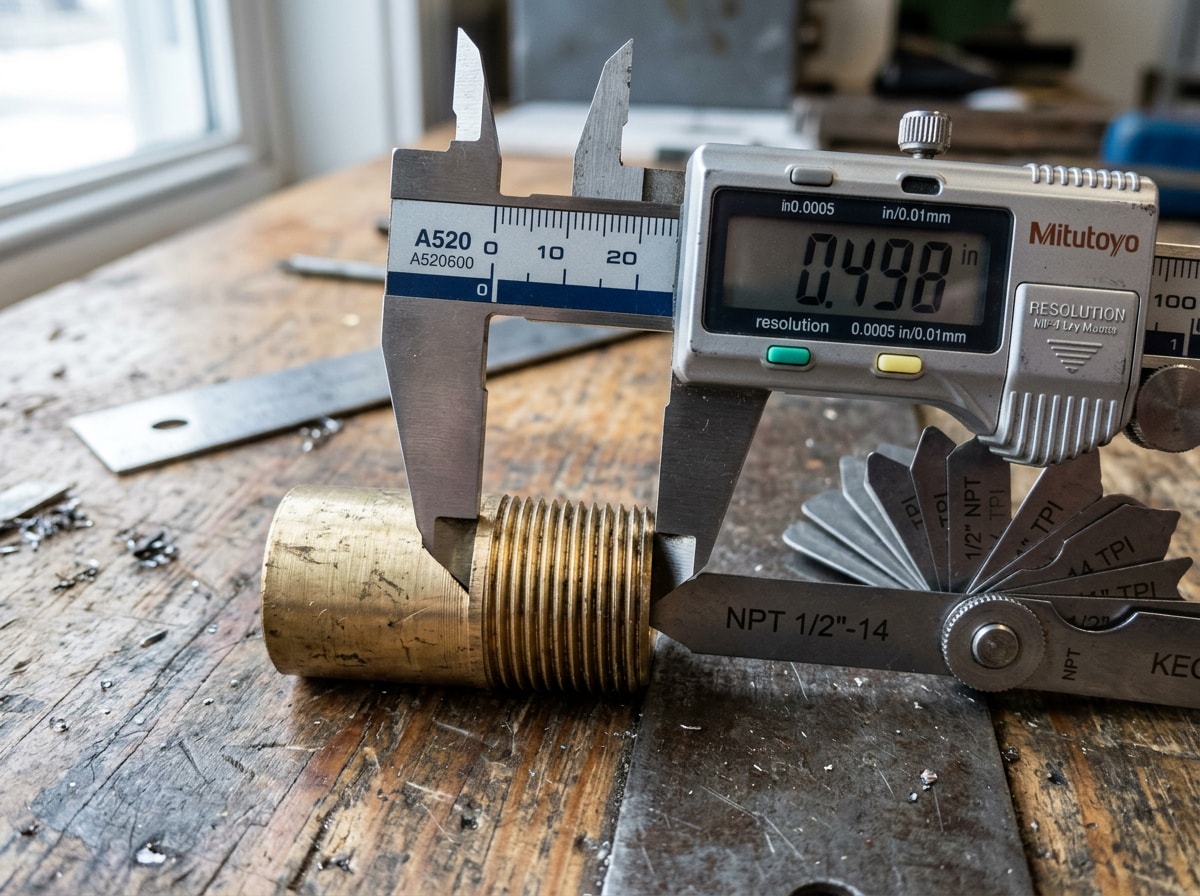
Here is what the male half of each common NPT size actually measures at the large end of the taper, along with its thread pitch:
| Nominal size | Male thread OD (approx.) | Threads per inch |
|---|---|---|
| 1/4" | 0.540" | 18 |
| 3/8" | 0.675" | 18 |
| 1/2" | 0.840" | 14 |
| 3/4" | 1.050" | 14 |
| 1" | 1.315" | 11.5 |
Notice that 1/2" and 3/4" share the same 14 threads per inch. That is why a pitch gauge alone cannot tell them apart. You need the diameter too.
A reliable identification sequence:
- Look at the opening. Threads inside mean FIP; threads outside mean MIP.
- Read the casting or molding stamp. Most fittings carry the size and sometimes the thread type.
- Measure the male OD with a caliper, then confirm the pitch with a thread pitch gauge.
- Easiest of all: bring the mating part with you and test-thread it at the counter.
Where FIP Fittings Show Up in a House
Walk through a typical home and the female half appears constantly:
- Under sinks and toilets: the angle stop shutoff valve usually has an FIP inlet that threads onto a male nipple or adapter coming out of the wall. Common work during toilet repair and installation.
- Water heaters: the tank's hot and cold ports are female; the nipples and dielectric unions screwing into them are male. Our water heater repair crews break these joints weekly.
- Behind shower trim: drop-ear elbows have an FIP socket that receives the male shower arm.
- At the sink deck: supply risers land on female ports during faucet installation and repair.
- Outside: a hose bibb body threads onto a male supply stub, with garden hose threads on the other end.
- Gas appliances: the shutoff valve feeding a dryer, range or furnace has a female port for the connector's male end.
That last one carries the most risk. In a long-running consumer warning about older uncoated brass appliance connectors, the CPSC reported 200 connector failures associated with 35 deaths and 59 injuries , and recommends that connectors be inspected only by a professional service provider . Read the CPSC warning on flexible gas connectors before you touch a fuel gas joint.
If you would rather not, our plumbing services team handles these every day.
How to Seal an FIP Connection Properly
The taper wedges the joint tight, but that fine spiral path still runs along the threads. Sealant fills it.
- Wipe both sets of threads clean and check for burrs or cross-threading damage.
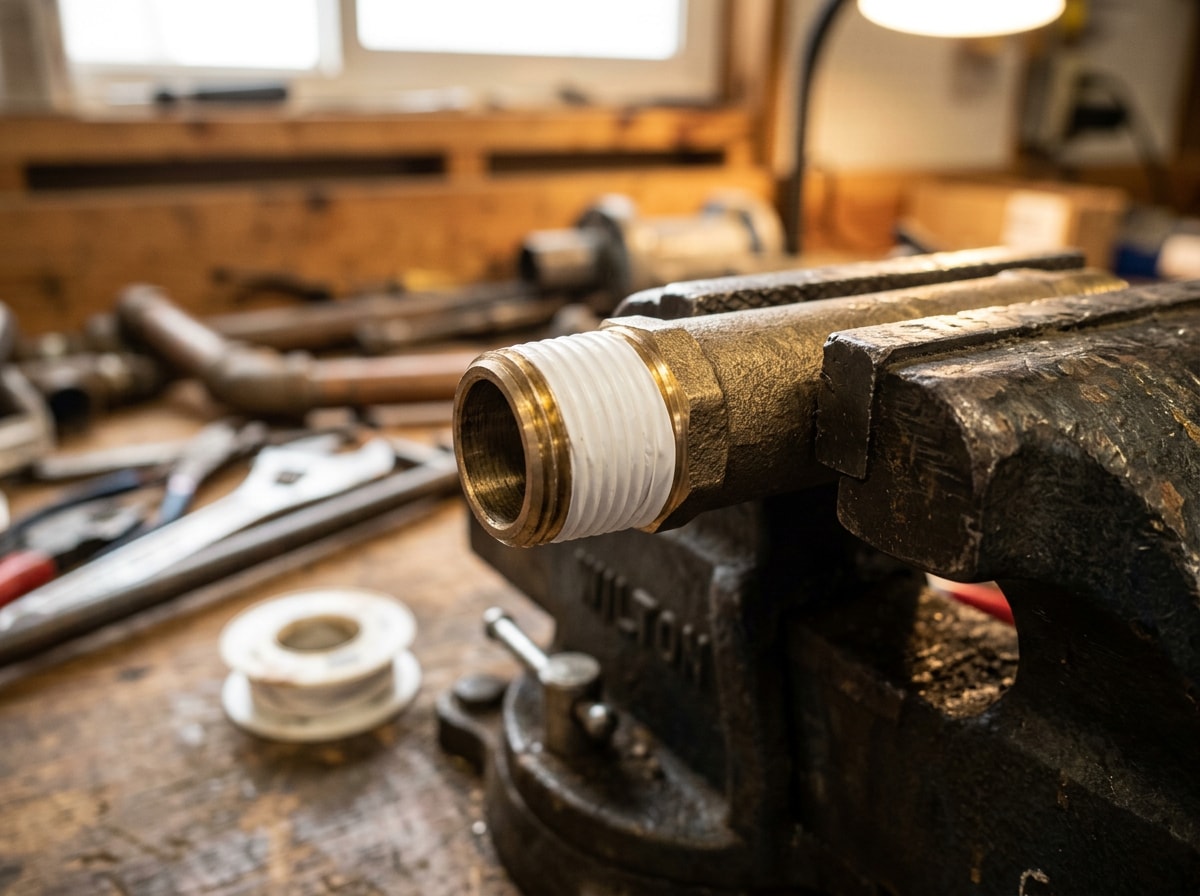
- Apply sealant to the male threads only.
- Start the joint by hand for two or three full turns.
- Wrench it snug, generally one to two turns past hand-tight.
Wrap PTFE tape clockwise as you face the end of the male fitting, 3 to 5 wraps, so tightening pulls the tape into the threads instead of unrolling it.
| Application | Best choice | Look for on the label |
|---|---|---|
| Potable water | PTFE tape or pipe dope | NSF/ANSI 61 certification |
| Natural gas or propane | Yellow gas-rated tape or gas-rated dope | Listed for fuel gas |
| High-pressure metal-to-metal | Dope over tape | Pressure rating on the tube |
| Compression joints | Neither | No sealant required |
Sealants count as joining and sealing materials on drinking water lines, and NSF/ANSI 61 covers exactly those materials, including gaskets, adhesives and lubricants that contact drinking water . Verify the mark against the NSF/ANSI 61 standard summary rather than trusting shelf placement.
A note from our own service calls: the FIP joints that fail most often are not under-sealed, they are over-torqued. One extra pull on a 1/2" brass angle stop split the female casting, and the homeowner found the drip a week later, after the cabinet base had already swelled.
Two rules follow from that:
- Never tape female threads. Shredded tape ends up in the valve seat.
- Never force a joint that will not start by hand.
Other Plumbing Abbreviations on the Same Shelf
FGH / MGH: female and male garden hose threads. Coarser than NPT and not interchangeable, though a hose bibb often has FIP on one end and MGH on the other.
FCM: female compression. Compression joints seal with a ferrule, not threads, so they need no tape or dope.
NPS: national pipe straight. Looks like NPT but will not wedge; it needs a gasket to seal.
PEX and CPVC: modern supply materials, both sold with molded or brass FIP adapters so they tie into existing threaded fittings. Our guide to PEX plumbing types and sizes covers those transitions in detail.
Slip or socket: no threads at all. A solvent-welded PVC socket is not an FIP port, even though both look like an open female end.
FAQ
Is FIP male or female?
Female. FIP fittings have internal threads cut inside the opening, and a male fitting screws into them. Quick check: hold the part up to the light and look into the bore. Visible thread ridges inside mean female.
What is MIP and FIP in plumbing?
MIP is male iron pipe, the half with external threads. FIP is female iron pipe, the half with internal threads. Both are cut to the same NPT standard, so a matching pair threads together.
Can 1/2" FIP connect to 1/2" NPT?
Yes, provided the NPT part is the male half. Nominal sizes must match, thread gender must be opposite, and both threads must be genuinely NPT-tapered rather than BSP or metric. A 1/2" male NPT nipple threads straight into a 1/2" FIP port.
Does an FIP connection need Teflon tape?
Yes, in nearly all tapered NPT joints. Apply tape or thread sealant to the male threads only, never inside the female fitting. Compression fittings are the exception: they seal mechanically with a ferrule and need no tape.
Is FIP the same as FPT?
For residential purposes, yes. FPT, FIPT and FNPT all describe the same internal NPT thread. Manufacturers use different labels because the fitting is often brass, plastic or stainless rather than iron.
How do I tell 1/2" FIP from 3/4" FIP?
Measure the mating male part across its threads. A 1/2" NPT male measures about 0.840" across, a 3/4" about 1.050". Both have 14 threads per inch, so pitch alone will not separate them.
What happens if you thread FIP into FIP?
Nothing threads at all. Two female ends cannot engage. You need a nipple or a male adapter between them, sized to match both ports.
When to Call a Licensed Plumber
Some of this is comfortably homeowner territory: swapping a toilet supply line, replacing a worn hose bibb, changing a faucet connector. Those are low-pressure joints you can test in a minute.
Draw the line at three situations:
- Gas line connections. Licensed plumber, full stop.
- Water heater connections. Temperature, pressure and dielectric pairing are all easy to get subtly wrong.
- A joint that has already leaked once. That usually means damaged threads or a cracked casting, not a sealant problem, and re-taping only delays a real leak repair or pipe repair and replacement.
If you are unsure which category you are in, that uncertainty is itself a good reason to call.
Aumenta Plumbing serves homeowners across northern and central New Jersey, including Westfield and Mountainside. Browse the full range of work on our homepage, or get a free estimate and we will identify the fitting for you before anything gets wrenched.