Indoor plumbing started around 2500 B.C., when builders in the Indus Valley and Egypt ran clean water and waste through pipes inside buildings. The plumbing you actually use, meaning pressurized supply lines, a flush toilet and a sealed drain, did not reach most American homes until the middle of the 20th century. Those two answers sit about 4,500 years apart, and the gap between them is the real story.
The Short Answer: Two Dates, Not One
Most arguments about this question come from mixing up two different milestones.
- Technology first appears: roughly 2500 B.C., in Bronze Age cities with drains, latrines and bathing rooms built into houses.
- Ordinary households get it: roughly 1940 to 1960 in the United States, when complete plumbing went from a minority feature to a near-universal one.
Everything below fills in the middle.
Ancient Indoor Plumbing: 2500 B.C. to 476 A.D.
The Indus Valley
The strongest claim to the first true indoor plumbing belongs to the Indus Valley cities of what is now Pakistan and northwest India. Mohenjo-daro is thought to have been built around 2500 B.C. and was the largest urban center of the Indus Valley civilization, covering nearly 500 acres.
What makes it remarkable is how ordinary the plumbing was. Almost all of the city's houses had indoor baths and latrines with drains, and the city also had a large public bathhouse.
Many buildings at Mohenjo-daro had two or more stories, and water from roof and upper storey bathrooms was carried through enclosed terracotta pipes or open chutes that emptied onto the street.
That is a second-floor bathroom drain, 4,500 years ago.
Ancient Egypt
Egyptian builders were working with copper drain lines by roughly 2500 B.C., including bathroom and drainage features built into royal tomb complexes.
Why put a bathroom in a tomb? Egyptians installed bathrooms and other plumbing fixtures in their tombs because they believed the dead should be supplied with the necessities of everyday life.
Above ground, canals and irrigation basins moved water to fields and cities. Egyptian plumbing was engineering and theology at the same time.
Ancient Rome
Rome pushed the idea further than anyone would again for more than a thousand years. Aqueducts carried fresh water into the city and out to surrounding towns, feeding public baths, fountains, some private homes and a large underground sewer system.
The pipes were often lead. The Latin word for lead is plumbum, which is where the word plumbing comes from.
Worth being clear about: running water inside the house was a luxury for wealthy Romans. Most people used public baths and public latrines. The supply lines our plumbing services team works on today serve every house on the street, which was never true in Rome.

The Middle Ages: When Indoor Plumbing Went Backward
After Rome fell, the engineering went with it. European cities returned to chamber pots, shared privies and cesspits dug behind houses. Water carriers hauled buckets from wells and streams. Waste went into gutters and rivers.
That regression is the key to this whole question. Roman-level plumbing existed, worked, and was then lost for centuries. The history of plumbing is not a straight line of progress.
1596 to 1775: The Flush Toilet and the S-Trap
Sir John Harrington, a godson of Queen Elizabeth I, devised a toilet that flushed using a seat, a water cistern and a lever-operated valve that emptied the bowl down a pipe to a cesspool. The year was 1596.
It solved half the problem. Because there was no plumbing system to carry waste into a sewer, Harrington's toilet was essentially a fancier chamber pot.
The missing piece arrived in 1775. Scottish inventor Alexander Cummings improved the design by adding the S-trap, a curving pipe that kept clean water sitting in the bowl, and he became the first inventor to receive a patent for a toilet.
That curve is still under every fixture in your house. When it dries out or gets pulled loose, sewer gas comes back into the room, which is one of the more common calls our toilet repair and installation crews get.
Indoor Plumbing Comes to America: The 1800s
This is the stretch where plumbing stopped being a curiosity and became infrastructure. Philadelphia moved from wooden log water mains to cast iron in the early 1800s, and New York's Croton Aqueduct began delivering water to the city in 1842.
Household plumbing followed the same curve. Until 1840, indoor plumbing could be found only in mansions and first-class hotels, and then in the decade before midcentury Americans across a wider range of incomes began installing household plumbing.
1829: The Tremont House in Boston
The Tremont Hotel of Boston became the first hotel of its kind to offer indoor plumbing for guests. Architect Isaiah Rogers gave it ground-floor water closets fed by a rooftop cistern and a steam pump.
Guests came partly to see it. The plumbing was advertised as an attraction, which tells you its status at the time: a marketable novelty, not a standard.
1833: Running Water at the White House
Even the most prominent house in the country got plumbing in pieces. According to the White House Historical Association, President Andrew Jackson had iron pipes installed in the Ground Floor Corridor and a bathing room in the East Wing in 1833, and by 1853 records indicate the Second Floor had central plumbing with hot and cold water taps.
Twenty years to get water to the second floor. That pace was normal.
Late 1800s: Thomas Crapper and the Modern Toilet
Thomas Crapper did not invent the flush toilet, but he patented various plumbing and drainage devices, including the floating ballcock, which lets a toilet tank refill without overflowing. We call that part a fill valve now, and it does the same job.
He was also responsible for popularizing bathroom systems as a marketable product. As for the slang, the word "crap" existed well before Crapper sold fixtures, though American soldiers in World War I who saw his name on chain-pull toilets in Europe brought "crapper" home as a euphemism.
When Did Indoor Plumbing Become Common in Homes?
Between about 1940 and 1960 in the United States. The census first asked about plumbing facilities in 1940.
Complete plumbing facilities means hot and cold piped water, a bathtub or shower, and a flush toilet. Here is how fast the country closed the gap, per U.S. Census Bureau historical housing tables:
| Census year | U.S. homes lacking complete plumbing |
|---|---|
| 1940 | Nearly half |
| 1950 | About one third |
| 1960 | About one sixth |
| 1970 | About 7 percent |
| 1980 | About 3 percent |
| 1990 | About 1 percent |
In 1940, about ten states had rates approaching or exceeding 70 percent lacking complete plumbing.
The toilet numbers are even blunter. In 1940 over a third of homes had no flush toilet, and of the 13 million units reporting none, 11.8 million had an outside toilet or privy.
As recently as 1950, a quarter of America's homes still had no flush toilet.
Three things closed the gap:
- Cities built municipal water and sewer networks through the second half of the 1800s, driven largely by cholera and typhoid outbreaks.
- Mass-manufactured fixtures got cheap enough for ordinary budgets.
- Postwar builders in the 1950s and 1960s included full plumbing in new homes by default instead of as an upgrade.
For a state-by-state look at that adoption curve, see our breakdown of when indoor plumbing became common.
How to Tell When Your Own House Got Indoor Plumbing
Most history articles stop at the national timeline. The more useful question for a homeowner is when your house got plumbed, and the pipes answer it.
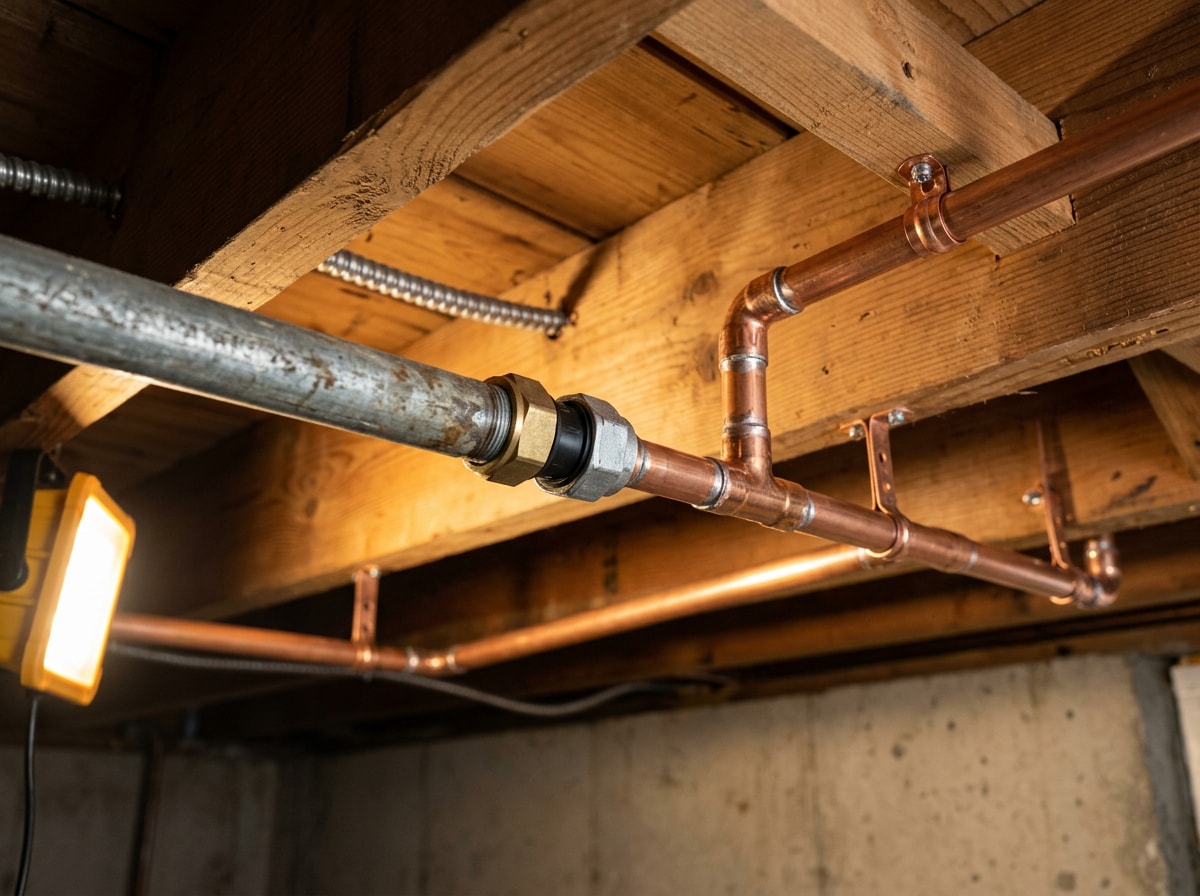
In older Westfield and Union County homes, the giveaway we see most often is a galvanized steel line spliced into copper at the basement ceiling. That is usually a 1910s or 1920s house that got its first real bathroom in the 1950s, and the splice point is exactly where corrosion tends to show up first.
Use these clues as a rough dating guide:
| What you find | Likely install era |
|---|---|
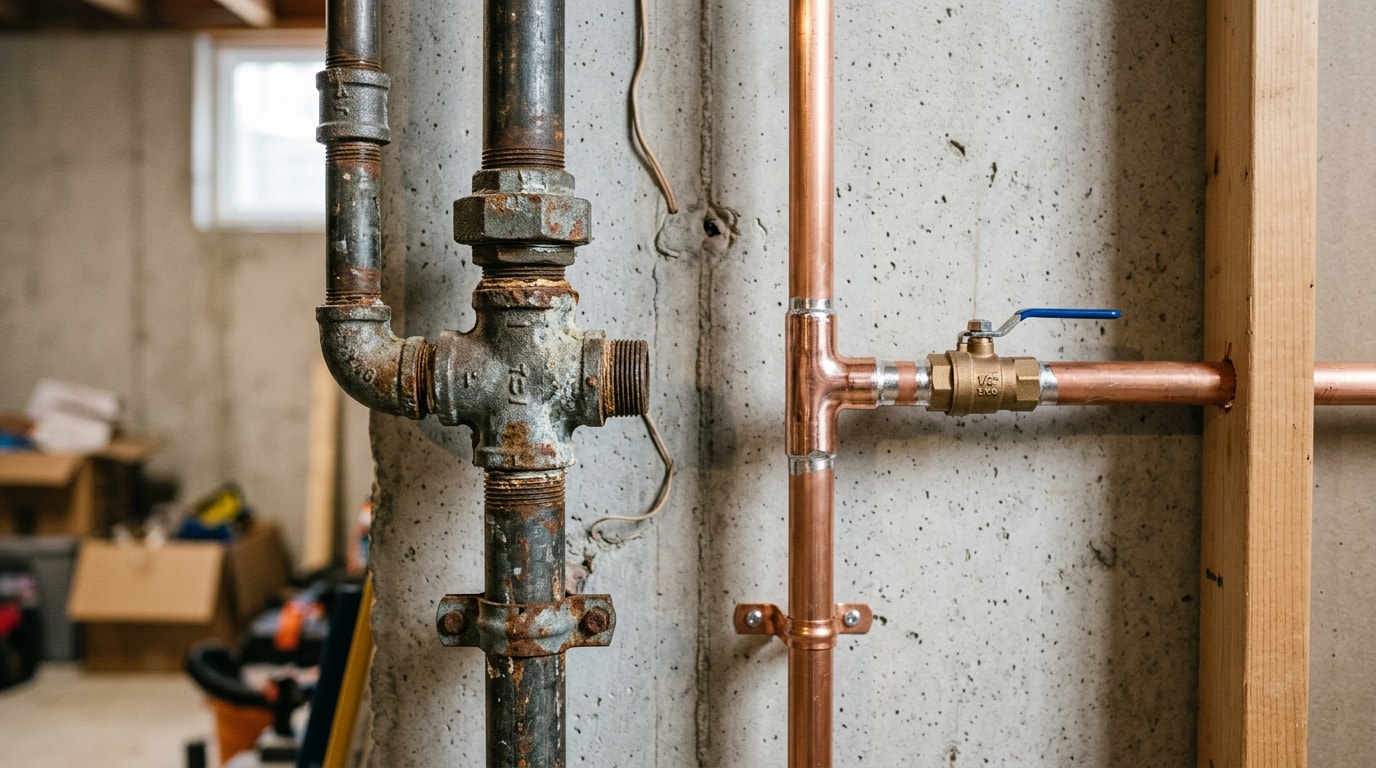
| Galvanized steel supply lines | About 1900 to 1955 |
| Cast iron drain stack with hub and lead joints | Before about 1970 |
| Copper supply with soldered joints | About 1950 to 2000 |
| PVC or ABS drain lines | 1970s onward |
| PEX supply with crimp rings | About 2000 onward |
| Bathroom tucked under a staircase or in a former closet | Retrofit into a pre-plumbing house |
Two practical notes from the field.
Galvanized steel scales up from the inside, so flow drops long before the pipe leaks. If your second-floor shower pressure dies when a faucet runs downstairs, the pipe is usually the cause, not the fixture.
Old cast iron drains fail at the bottom of the stack and at the transition to the yard line, which is where sewer line repair and pipe repair and replacement work usually starts in a pre-war house.
If you are not sure what you are looking at, get a free estimate and have someone identify the material before you plan a renovation around it.
Modern Plumbing Milestones
Hot Water on Demand
The systems that made plumbing genuinely livable are mostly 19th and 20th century work. Domestic water heaters appeared in the 1870s, and Edwin Ruud's automatic gas-fired storage tank heater in 1889 is the direct ancestor of the unit in your basement. Tank design has changed less than people assume, which is why water heater installation still follows the same venting and relief-valve logic it did a century ago.
Pipes: Clay to Copper to PEX
Clay was the ancient default: durable, brittle, and impossible to pressurize. Cast iron took over for mains and drains. Galvanized steel dominated household supply lines into the mid-1900s until corrosion and scale exposed its limits.
Copper replaced it because it was lighter, cleaner and longer lived. Copper price spikes in the 1960s pushed builders toward plastics, and PVC, CPVC and eventually PEX took hold. The plastics stayed because they were cheaper, flexible and faster to install.
Water Conservation Rules of the 1980s and 1990s
Once plumbing was universal, the volume it used became the problem. State laws in the 1980s and federal rules in the 1990s capped fixture flow rates to save water and the energy used to heat it.
The Energy Policy Act of 1992 set the maximum flush volume for tank-type and flushometer toilets at 1.6 gallons per flush.
Design improvements since then let toilets use 1.28 gallons per flush or less, which is 20 percent below that federal standard, according to EPA WaterSense.
That matters during a bathroom remodel in an older home. Drain lines sized for 5-gallon flushes do not always move waste well on 1.28 gallons, especially on long horizontal runs with a shallow slope.
FAQ
When did indoor plumbing start?
Around 2500 B.C. Indus Valley cities such as Mohenjo-daro had houses with bathing rooms, latrines and connected drains. Nothing resembling modern indoor plumbing, meaning pressurized supply, flush fixtures and a connected sewer, existed until the 1700s and 1800s.
Who invented indoor plumbing?
No single person. It is a chain of innovations. Harrington built the first flush toilet in 1596, Cummings patented the S-trap in 1775, and Crapper's improvements and marketing in the late 1800s made the water closet an ordinary purchase.
Did the Romans have indoor plumbing?
Yes, but not for everyone. Aqueducts fed public baths, fountains and sewers, while piped water inside the home was mostly limited to wealthy households.
When did houses start having indoor plumbing?
Wealthy American homes and first-class hotels had it by the 1830s and 1840s. It became typical in new urban construction around 1900 and standard nationwide between 1940 and 1960.
Did homes in the 1920s have indoor plumbing?
Many city homes did. Many rural and farm homes did not. As late as 1940, over a third of U.S. homes still had no flush toilet.
What did people use before indoor plumbing?
Chamber pots indoors, outhouses and pit privies outdoors, and cesspits for storage. Water came from wells, cisterns, rivers or public fountains, carried by bucket.
Why is it called plumbing?
From plumbum, the Latin word for lead, because early pipes were made of lead. That is also why lead's chemical symbol is Pb.
How do I know if my home's plumbing needs updating?
Low pressure, rust-colored water, recurring slow drains and visible green or white corrosion at joints are the usual signs. A camera inspection settles it. Start with the Aumenta Plumbing homepage to see what we cover, or contact us to schedule a look at your system.