Indoor plumbing became common in American homes between the 1940s and the 1960s, not in the Victorian era most people picture. Running water and flush toilets existed in wealthy houses by the 1850s, but the federal government did not even count plumbing in homes until 1940, and at that point nearly half of U.S. houses still came up short. Here is the decade by decade record, and why the date you see quoted online is usually wrong.
The Short Answer
Indoor plumbing crossed from luxury to expectation in the middle of the 20th century.
Three things had to line up first:
- Infrastructure. Cities had to extend water and sewer mains into new suburbs and rural counties.
- Price. Factories had to make tubs, toilets and sinks cheap enough for a middle-class budget.
- Code. Building codes had to require fixtures in new construction instead of merely permitting them.
That is also why you see wildly different dates quoted elsewhere. Some answers describe when plumbing was invented, others when it was available to buy, and others when it was actually common. Three questions, three different answers.
One definition matters before the numbers. The Census Bureau defines complete plumbing facilities as hot and cold piped water, a bathtub or shower, and a flush toilet. A house with a cold tap at the kitchen sink and a privy out back does not count.
The Census Timeline: Decade by Decade
Here is the part most history pages skip. There is no national count of plumbing in American homes before 1940. The first U.S. Census of Housing was taken in 1940. Every percentage you see quoted for 1900, 1910 or 1920 is an estimate or a reconstruction, not a census figure, which is exactly why those numbers contradict each other from site to site.
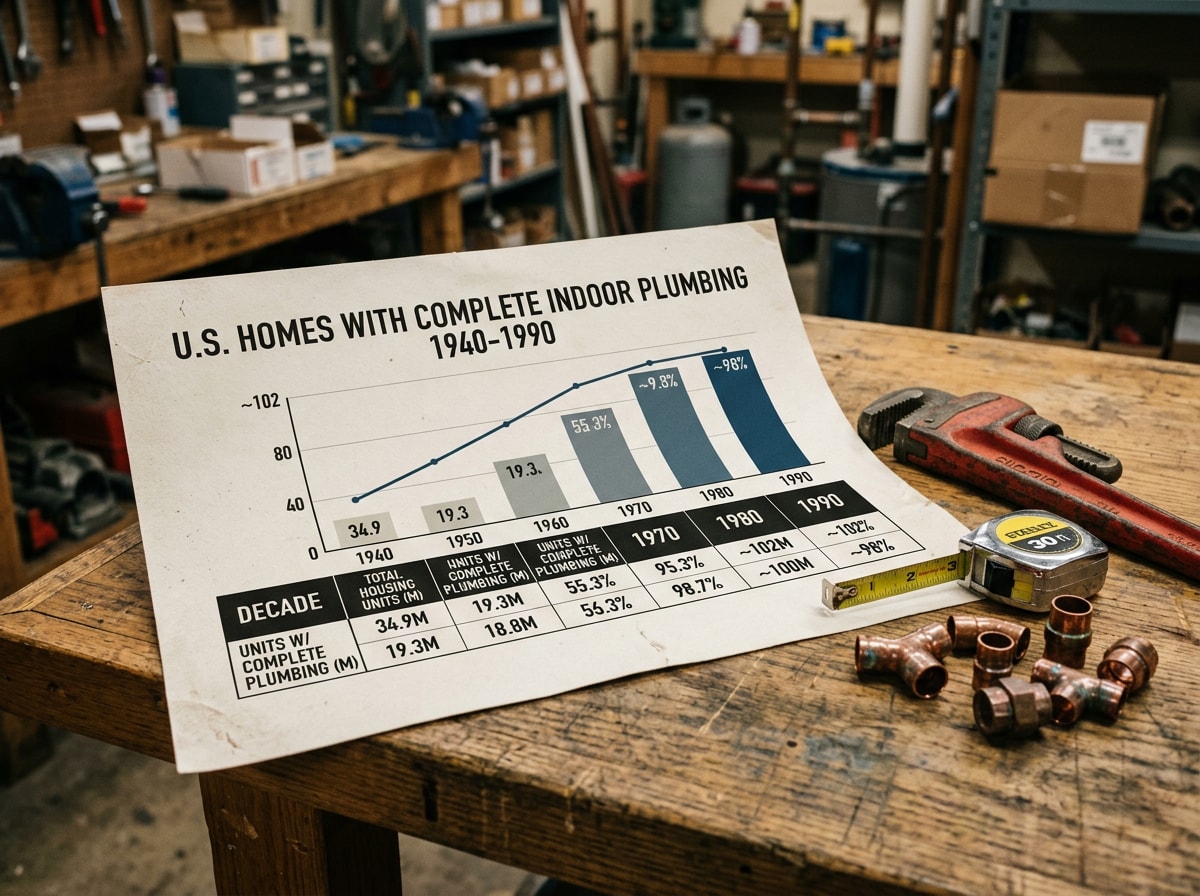
| Census year | U.S. homes with complete plumbing | What was driving the change |
|---|---|---|
| Before 1940 | No national count exists | Tenement codes, mass-produced porcelain fixtures, city water and sewer expansion |
| 1940 | About 55 percent | First housing census; National Bureau of Standards research shapes modern plumbing codes |
| 1950 | About two-thirds | Postwar building restarts; wartime housing shortage eases |
| 1960 | About 83 percent | Suburban tract construction; federal water and sewer funding reaches smaller towns |
| 1970 | About 93 percent | Full plumbing standard in new construction |
| 1990 | About 99 percent | Remaining gaps concentrated in a handful of states |
The census language behind that table is blunt. In 1940 nearly half of American homes lacked complete plumbing, about ten states had rates approaching or exceeding 70 percent, and the share lacking it fell to roughly one-third in 1950 and one-sixth in 1960.
By 1990 only 1 percent of homes lacked complete plumbing.
So the crossover point, the moment more than half of U.S. homes had it, sits in the 1940s. That is the defensible answer to "became common."
The Outhouse Numbers Are Even More Striking
Toilets tell the story better than averages do. In 1940, over a third of American homes had no flush toilet, and of the 13 million units reporting none, 11.8 million relied on an outside toilet or privy while another million had no toilet or privy at all.
As recently as 1950, a quarter of America's homes still had no flush toilet, with some states topping 50 percent.
The regional spread was enormous. About 80 percent of Mississippi homes had no flush toilet in 1940.
Read that against a Chicago or Boston apartment of the same year and you get the real answer: indoor plumbing became common in cities a generation before it became common in the countryside.
The Postwar Boom Finished the Job
The construction wave after World War II did the heavy lifting.
Millions of tract homes went up with full plumbing included, financed by GI Bill mortgages and rising homeownership. Galvanized steel gave way to copper for supply lines. Two-bathroom floor plans shifted from indulgence to expectation.
Outhouses faded through the 1960s as sewer and septic hookups spread. By the 1970s, new houses shipped with modern plumbing by default. PVC drain lines and, later, flexible PEX tubing cut installation time and cost, which made full plumbing affordable even in modest builds.
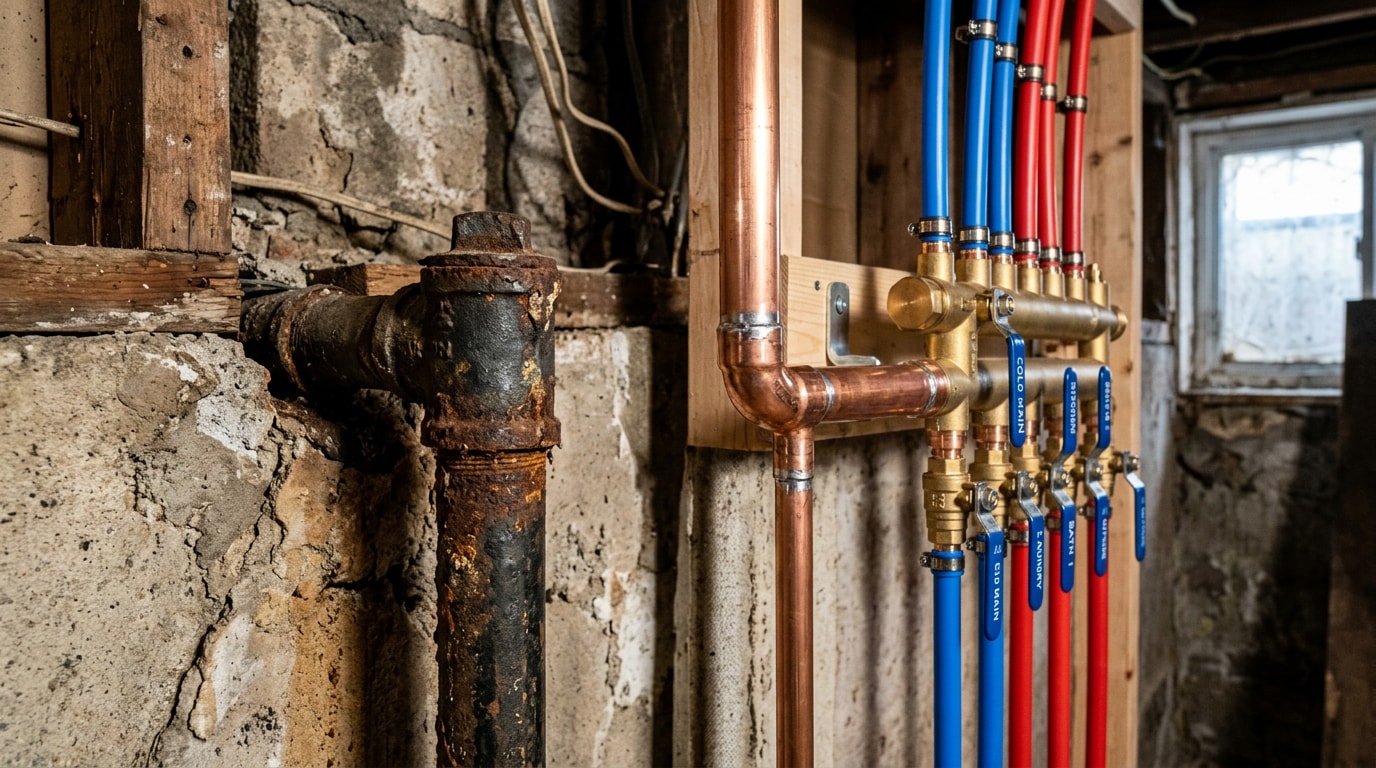
Those postwar houses are now 50 to 80 years old. Original galvanized supply lines and early copper are at or past the end of their service life, which is why so many of them need pipe repair and replacement rather than another patch.
How Indoor Plumbing Arrived in America
Early American households relied on dug wells, rainwater cisterns and backyard outhouses. Water came inside by bucket, not by pipe.
That started changing in the 1830s and 1840s in Boston, New York and Philadelphia, where the first systems showed up in mansions, first-class hotels and government buildings. Boston's Tremont House, opened in 1829, is widely credited as the first American hotel with indoor plumbing, including ground-floor bathing rooms and water closets. The White House got running water in the 1830s, with an upstairs washroom following in the 1850s.
Even among wealthy urban households, a fixed bathtub with piped hot and cold water was unusual in 1850. This was the moment indoor plumbing arrived in America. It was not the moment it became normal.
The Infrastructure That Made It Possible
The 1800s supplied the pipes in the street before homes could use them.
- Philadelphia built one of the country's first municipal waterworks and laid cast iron mains in the early 1800s.
- New York's Croton Aqueduct began delivering water to the city in 1842.
- Major cities dug purpose-built sewers through the second half of the century.
- Alexander Cummings patented an S-shaped water trap in 1775, the ancestor of today's P-trap.
- Mass-produced vitreous china fixtures and early tank water heaters arrived near the century's end.
Demand came from fear as much as convenience. Once germ theory replaced miasma theory, cholera and typhoid turned sanitation into a public health argument rather than a preference.
One correction worth making: Thomas Crapper did not invent the toilet. Sir John Harington's 1596 device and Cummings' 1775 patent came first. Crapper manufactured, improved and marketed fixtures decades later. If you want the full arc, we walk through it in our guide to when indoor plumbing was invented.
Before America: Ancient Systems and the Long Gap
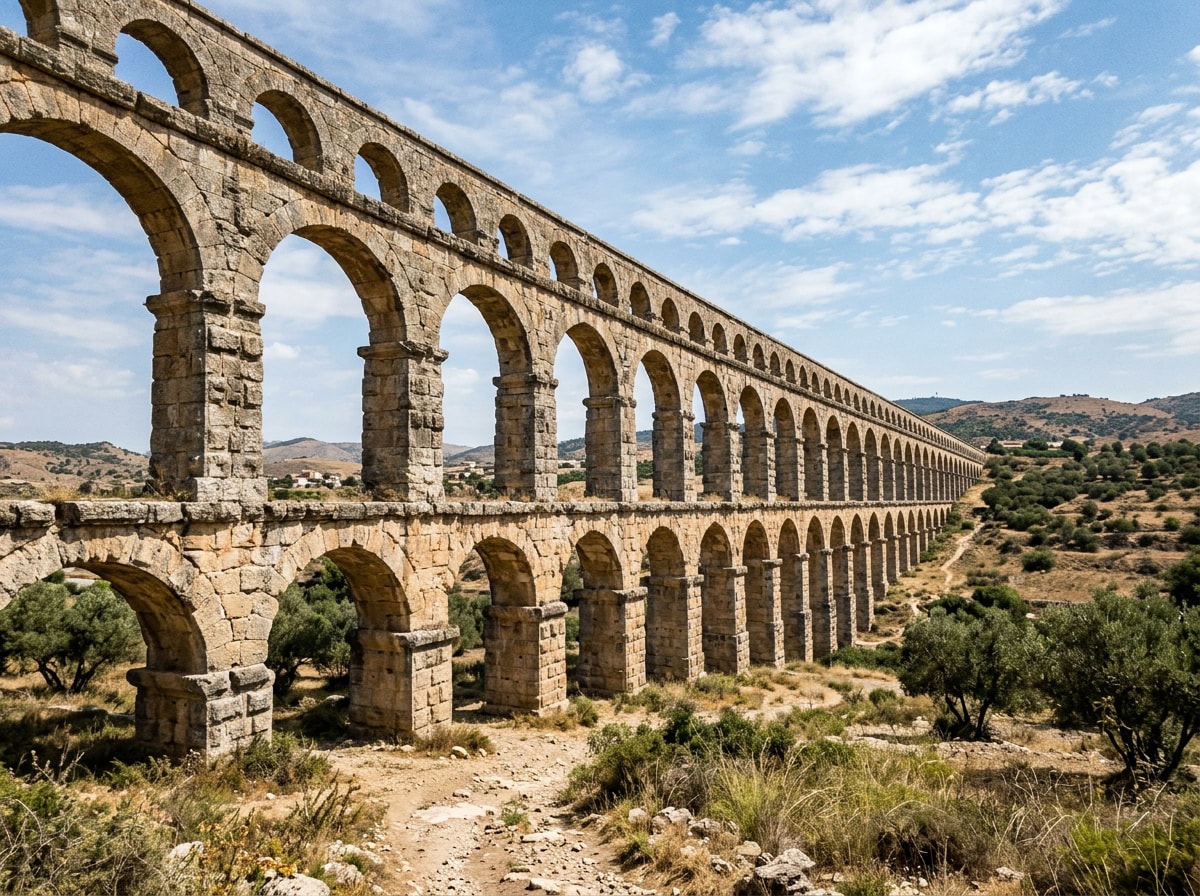
Piped water is thousands of years older than most people assume. The catch is that nearly every early system served palaces, temples and public buildings, not ordinary households.
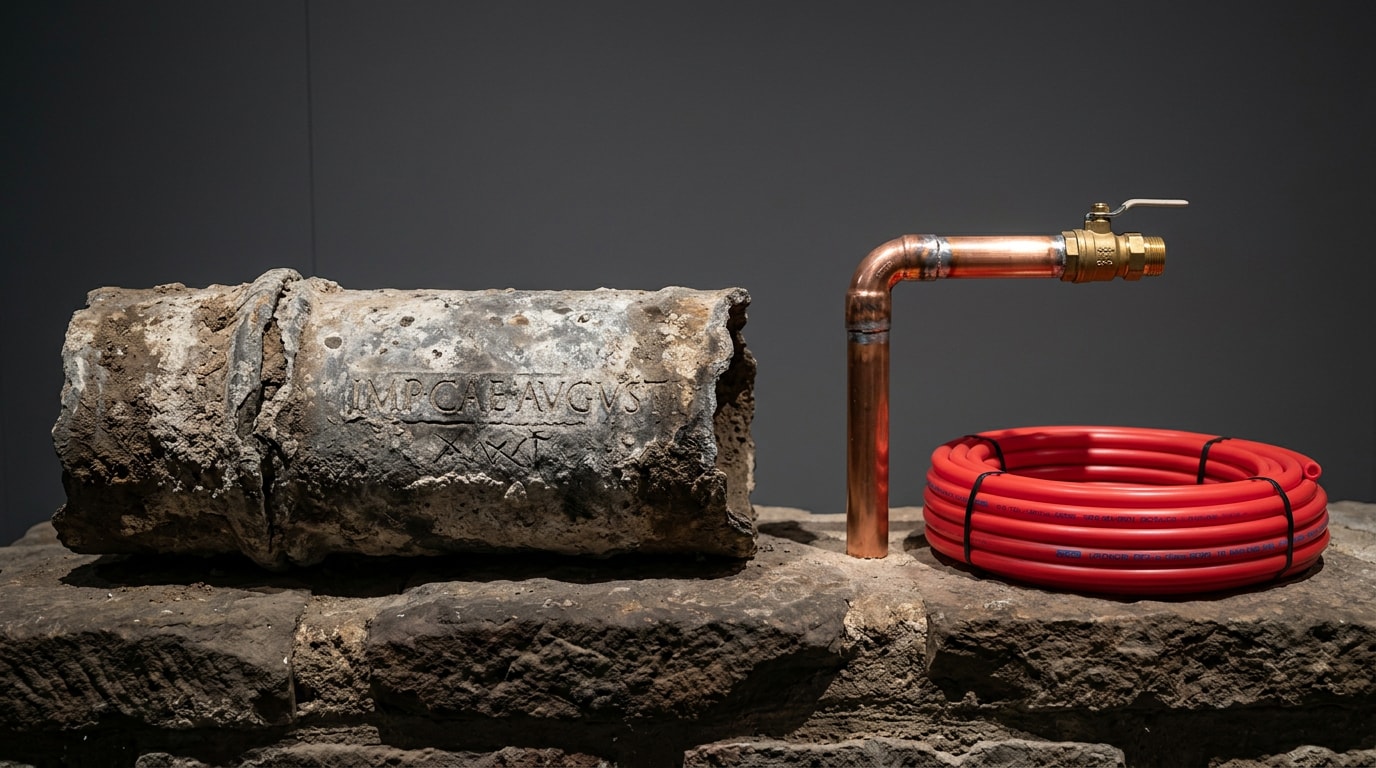
Rome scaled it furthest. Aqueducts carried fresh water into cities by gravity, sewers such as the Cloaca Maxima carried waste out, and public baths served hundreds of thousands of residents. Wealthy Roman homes tapped that supply directly with basins and private latrines. Everyone else used communal facilities. The lead pipes feeding those houses also gave us the word itself, since the Latin for lead is plumbum.
Earlier cultures laid the groundwork. Egyptian copper piping dates to around 3000 BC, and the Minoan palace at Knossos had drainage and flushing fixtures centuries before Rome existed.
Then came the reversal. After Rome's collapse, most of Europe lost the engineering and the tax base needed to maintain sewers. Households went back to chamber pots, shared privies over cesspits, and water hauled from wells by hand. Some monasteries and castles kept crude piped water and latrine chutes running, so the decline was uneven rather than total.
The distance between the first piped water and the average family having it at home is roughly five thousand years.
The Story Is Not Finished
A small but real share of U.S. households still lack complete plumbing. Research published in PNAS estimated that about 471,000 households, or 1.1 million people, lack a piped water connection.
Here is the counterintuitive part. Most coverage frames this as a rural Appalachia and tribal lands issue, and those communities do carry the highest rates. But 73 percent of households without piped water are located in cities, close to networked supply, and the total is roughly the population of San Jose, California. Plumbing poverty in 2026 is often a housing and cost problem, not a pipeline distance problem.
Aging materials are the other open issue. The EPA estimates about 4 million lead service lines still serve properties across the United States, and lead pipes and brass or bronze fixtures remain the most common sources of lead in drinking water. Corroded galvanized supply lines sit in the same housing stock.
Meanwhile, low-flow fixtures, greywater reuse and smart leak detection are pushing modern systems toward efficiency rather than raw volume.
What This Means If You Own an Older Home
History stops being trivia the moment it is behind your own walls. Roughly speaking:
- Pre-1900 homes: original waste lines are long gone. What remains is usually a patchwork of cast iron, clay and later replacements. Root intrusion and bellied clay lines are common, which is why these houses so often need sewer line repair.
- 1900s to 1940s: galvanized steel supply lines. They corrode from the inside out, so pressure drops and rusty water show up long before a visible leak does. Pinhole failures usually mean leak repair first, repiping second.
- 1950s to 1970s: early copper and cast iron drains, plus first-generation two-bath layouts. Fixture upgrades and toilet repair or replacement are the usual entry point, often alongside a bathroom remodel.
- Any of the above: the water heater is almost never original. If yours is past 12 years, plan the replacement or upgrade before it decides for you.
We work in a lot of this housing stock. In the prewar homes we repipe around Westfield and Morristown, it is routine to open a wall and find three eras of pipe spliced together, galvanized into copper into PEX, with the oldest section quietly choking flow to the whole second floor.
If your house predates the 1970s, an inspection tells you what is actually behind the plaster. Get a free estimate and we will walk the system with you.
FAQ
When did indoor plumbing become common in rural areas?
Roughly twenty years after cities. Federal rural electrification and water programs from the 1930s onward made well pumps and pressurized systems practical, and postwar sewer and septic expansion finished the job through the 1950s and 1960s.
Did homes in the 1920s have indoor plumbing?
Many urban homes did, especially newer apartments built under early 20th century tenement codes. Most farm homes did not. No national census counted plumbing before 1940, so any exact 1920s percentage you see is an estimate.
What percentage of homes had indoor plumbing in 1950?
About two-thirds had complete plumbing facilities. A quarter of American homes still had no flush toilet in 1950.
When did indoor bathrooms replace outhouses?
Between the 1940s and the 1960s for most of the country. City adoption ran from the 1900s through the 1920s, rural programs helped in the 1930s, and postwar tract construction closed the gap.
When did indoor plumbing become common in the UK?
Later than most people expect. Indoor sanitation reached middle class British households in the late 19th century, but sustained government intervention in the second half of the 20th century was required before all homes were upgraded.
When was indoor plumbing invented?
The earliest known water pipes date to roughly 3000 BC in Egypt, with Minoan Crete following with flushing fixtures and underground drains. The modern flush toilet traces to Harington's 1596 design and Cummings' 1775 patent.
Do any U.S. homes still lack indoor plumbing?
Yes. An estimated 471,000 households lack a piped water connection , and about 4 million lead service lines still serve U.S. properties .
Is my old house's plumbing worth replacing or repairing?
If the failures are isolated, repair. If you have galvanized supply lines, repeated pinhole leaks, low pressure at multiple fixtures, or discolored water, replacement is usually the cheaper path over five years.
Aumenta Plumbing is a licensed, insured New Jersey plumbing and heating contractor working on homes from the 1880s to new construction. See our plumbing services or start at our homepage to find your town, and contact us for a free estimate on repiping, sewer work or fixture upgrades.
Sources: U.S. Census Bureau Historical Census of Housing Tables on plumbing, PNAS research on insecure water access in U.S. cities, and EPA guidance on lead service lines.