
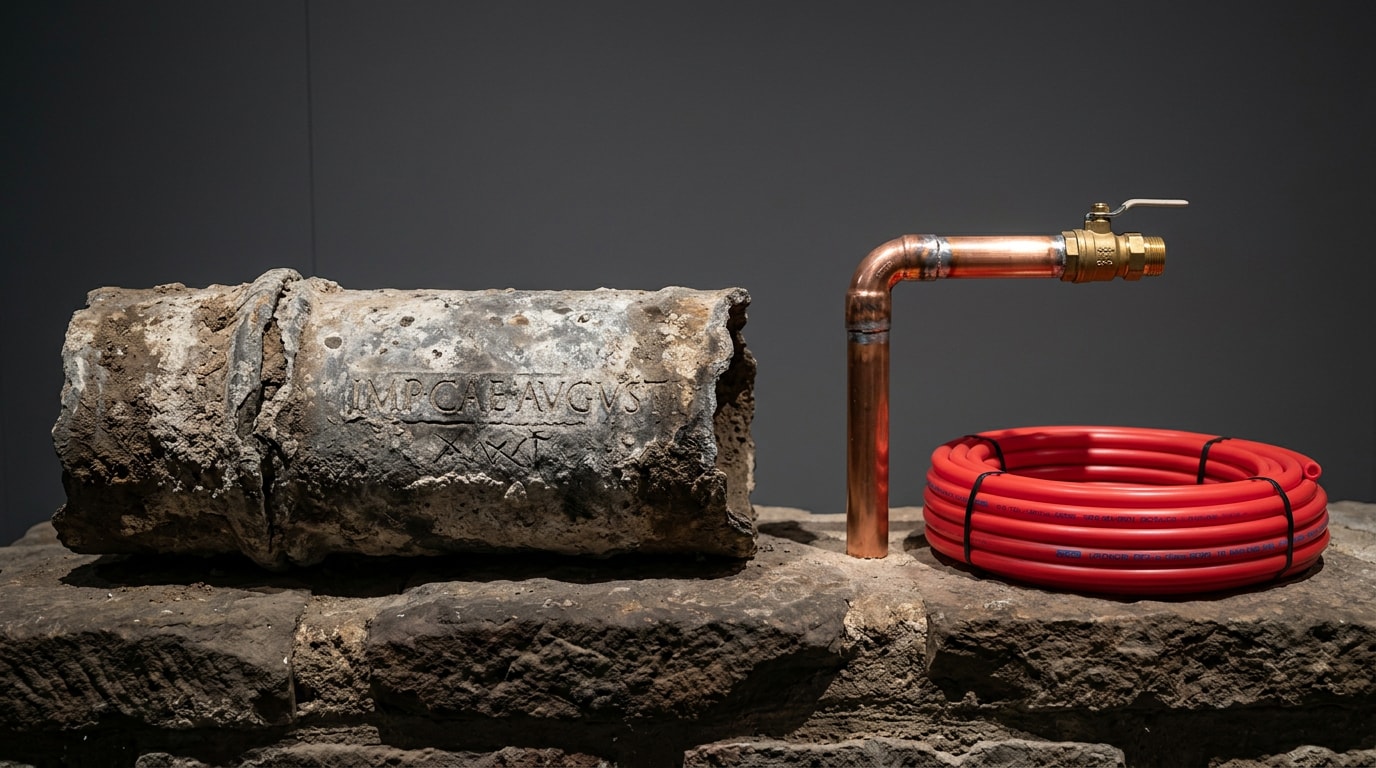
When was indoor plumbing invented? There is no single date, because pipes, flush toilets and connected sewers each arrived centuries apart, with the oldest known water pipes dating to roughly 3000 BC. The stranger part is how recently the story ended: when the Census first counted plumbing in 1940, nearly half of American homes lacked complete plumbing facilities, compared with only 1 percent by 1990 .
The Short Answer, Plus a Timeline You Can Scan
Indoor plumbing was not invented once. It was assembled over about 5,000 years from three separate pieces: a pressurized water supply, a drain that carries waste away, and a sealed fixture that keeps sewer gas out of the room.
Use that three-part test on every milestone below. A pipe alone is not plumbing. A toilet with nowhere to drain is not plumbing either.
| Date | Milestone |
|---|---|
| c. 3000 BC | Earliest known clay and copper water pipes in Egypt and Mesopotamia |
| c. 2500 BC | Indus Valley cities use seated toilets connected to covered street drains |
| c. 1700 BC | Palace at Knossos, Crete: water-flushed closet plus underground drainage |
| 312 BC | Rome's first aqueduct, the Aqua Appia, begins supplying the city |
| 1596 | Sir John Harington builds a working water closet for Elizabeth I |
| 1775 | Alexander Cummings patents the S-trap water seal |
| 1804 | Philadelphia starts installing cast-iron water mains |
| 1829 | Boston's Tremont Hotel opens with eight water closets |
| 1842 | New York's Croton Aqueduct delivers pressurized city water |
| 1940 | Nearly half of U.S. homes still lack complete plumbing |
| 1990 | About 1 percent of U.S. homes lack complete plumbing |
Ancient Plumbing: Egypt, the Indus Valley, and Crete
Egypt's Copper Pipes
The earliest known water pipes appear around 3000 BC, and by roughly 2500 BC Egyptian builders were running copper piping into pyramids and tombs to serve bathrooms.
The motive was religious. The dead were believed to need everyday facilities, so those facilities were plumbed.
One caveat: published dates range from about 4000 BC to 2500 BC. Archaeological dating leans on stratigraphy and material analysis, so a range is more honest than a single year.
The Indus Valley
Harappa and Mohenjo-daro had seated toilets connected to covered drains running under the streets.
That is the first time the supply, the fixture and the drain show up together at city scale.
Crete and the First Flushing Toilet
The Minoan palace at Knossos held what is usually called the first flushing toilet. A seated closet was flushed by pouring water from a jug, and the waste ran into terracotta channels.
The same palace had bathtubs and an underground sewage system that moved waste away from living space. Estimates for the system range from about 1700 BC to 1000 BC, depending on which building phase is dated.
Rome: Aqueducts, Lead Pipes, and the Cloaca Maxima
Rome scaled the idea up. By the third century AD, eleven major aqueducts fed the city by gravity, supplying fountains, public baths and, for those who paid the fee, pipes inside private homes.
Waste drained into the Cloaca Maxima, a covered trunk sewer emptying into the Tiber.
The word plumbing comes from this era. Roman crews soldered water pipes from rolled lead sheet, and the Latin for lead is plumbum. The University of Chicago's classical reference on lead use in Roman water systems notes that the tradesmen who made those pipes were called plumbarii, which is where the modern job title comes from.
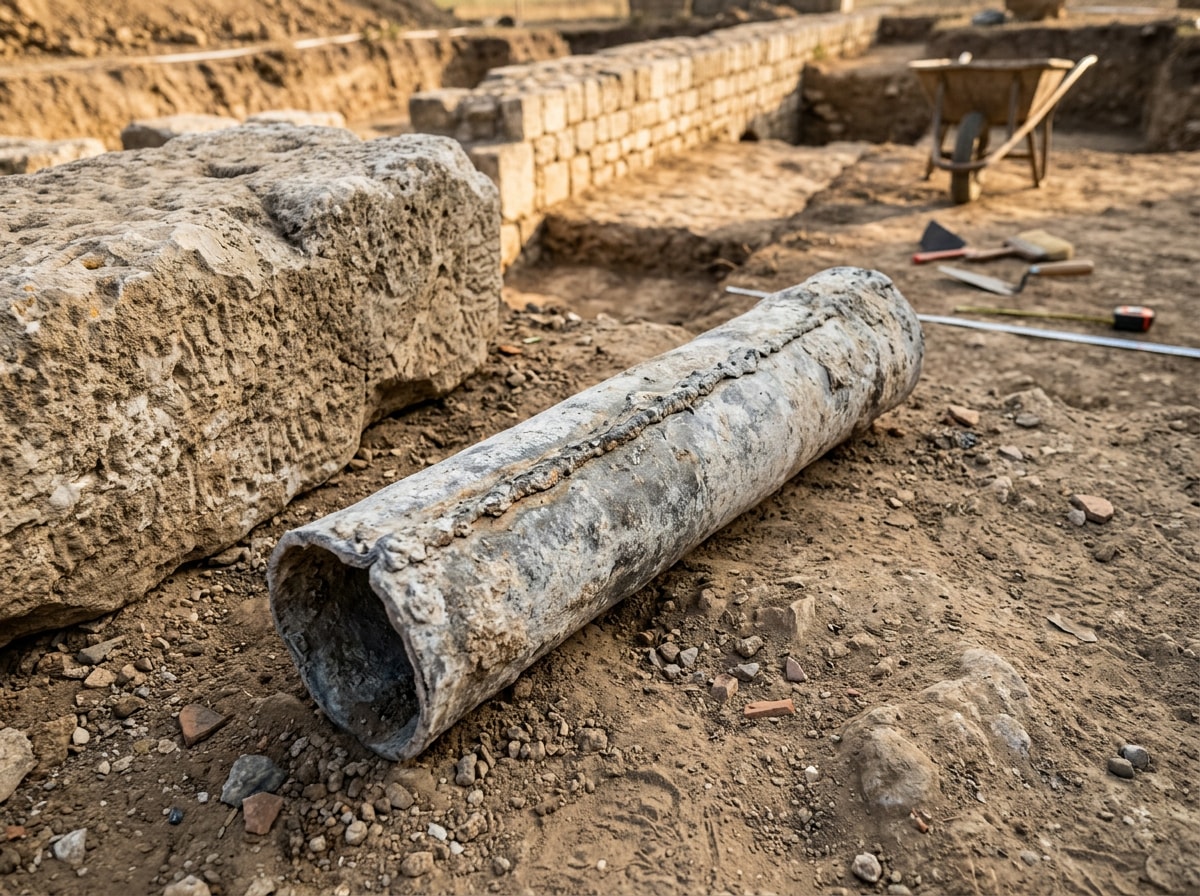
When the Western empire fell, the maintenance knowledge went with it. Aqueducts silted up, and Europe spent roughly a thousand years hauling water by bucket and emptying chamber pots into the street.
That gap is why the next real milestone sits almost 1,100 years later.
The First Modern Flush Toilet: Harington, Cummings, and Crapper
In 1596, Sir John Harington built a water closet for his godmother, Queen Elizabeth I. It flushed. It also went nowhere, because there was no sewer to connect it to, so waste sat in a cesspit below the house and the smell came back up.
In 1775, Scottish watchmaker Alexander Cummings patented the S-trap. That is the bend in the outflow pipe that holds standing water and blocks sewer gas from entering the room.
It was the first toilet patent, and the principle is still under every sink in your house. When we get a call about a sewer smell in a bathroom, the cause is almost always a dry or damaged version of that same 250-year-old water seal.
Thomas Crapper, a London plumber, arrived in the late 1800s. He refined the siphon flush, promoted the floating ballcock, and, more importantly, sold toilets to a public that finally had sewers to drain them into.
The claim that his name gave English the slang term is disputed. The word appears well before his career, so treat it as trade lore rather than fact.
The through-line matters more than the trivia: the fixture existed for nearly 300 years before the infrastructure that made it usable.
Indoor Plumbing Comes to America
First a Luxury for the Wealthy
In 1828 and 1829, architect Isaiah Rogers designed Boston's Tremont Hotel with eight water closets and running water on the ground floor. It was the first American hotel with indoor plumbing.
In 1833, the White House got running water on its main floor. Upstairs bathing facilities waited until the 1850s.
Until about the 1840s, that was the whole picture. Mansions, luxury hotels and the presidency had plumbing. Everyone else used a well, a hand pump and an outhouse.
The plumbing work that is routine today was bespoke, expensive craftsmanship then.
Then City Water Mains and Sewers
- Philadelphia began swapping bored wooden logs for cast-iron water mains between 1804 and 1815.
- New York's Croton Aqueduct opened in 1842, and its pressurized supply is what made upper-floor fixtures practical.
- Chicago adopted the first comprehensive American sewerage plan in 1855, and Brooklyn built a planned sewer system in 1857.
Cities spent that money for a reason. Cholera and typhoid outbreaks convinced officials that open waste and contaminated water were killing residents.
Sanitation became a public health investment rather than a comfort, which is the same logic behind modern sewer line repair and drain cleaning.
When Did Indoor Plumbing Become Common in Homes?
Not in the 1800s. Complete indoor plumbing did not reach most American homes until the mid-20th century, and rural areas trailed cities by decades.
The Census Bureau's historical housing tables settle it. In 1940 nearly half of homes lacked complete plumbing, about ten states had rates approaching or above 70 percent, and the national share fell to roughly one-third in 1950 and one-sixth in 1960 . Complete plumbing means hot and cold piped water, a bathtub or shower, and a flush toilet.
Here is the detail most timelines skip. Census figures on toilet facilities show that of the 13 million units reporting no flush toilet in 1940, 11.8 million used an outside toilet or privy and about one million had no toilet or privy at all .
State-level numbers are starker still. Roughly 80 percent of Mississippi homes had no flush toilet in 1940, and by 1990 only 4 percent lacked a public sewer, septic tank or cesspool .
Three things closed the gap:
- Municipal water and sewer lines pushing into new suburbs.
- Mass-manufactured fixtures getting cheap enough for ordinary budgets.
- Public health work in the 1930s that produced America's first national plumbing codes.
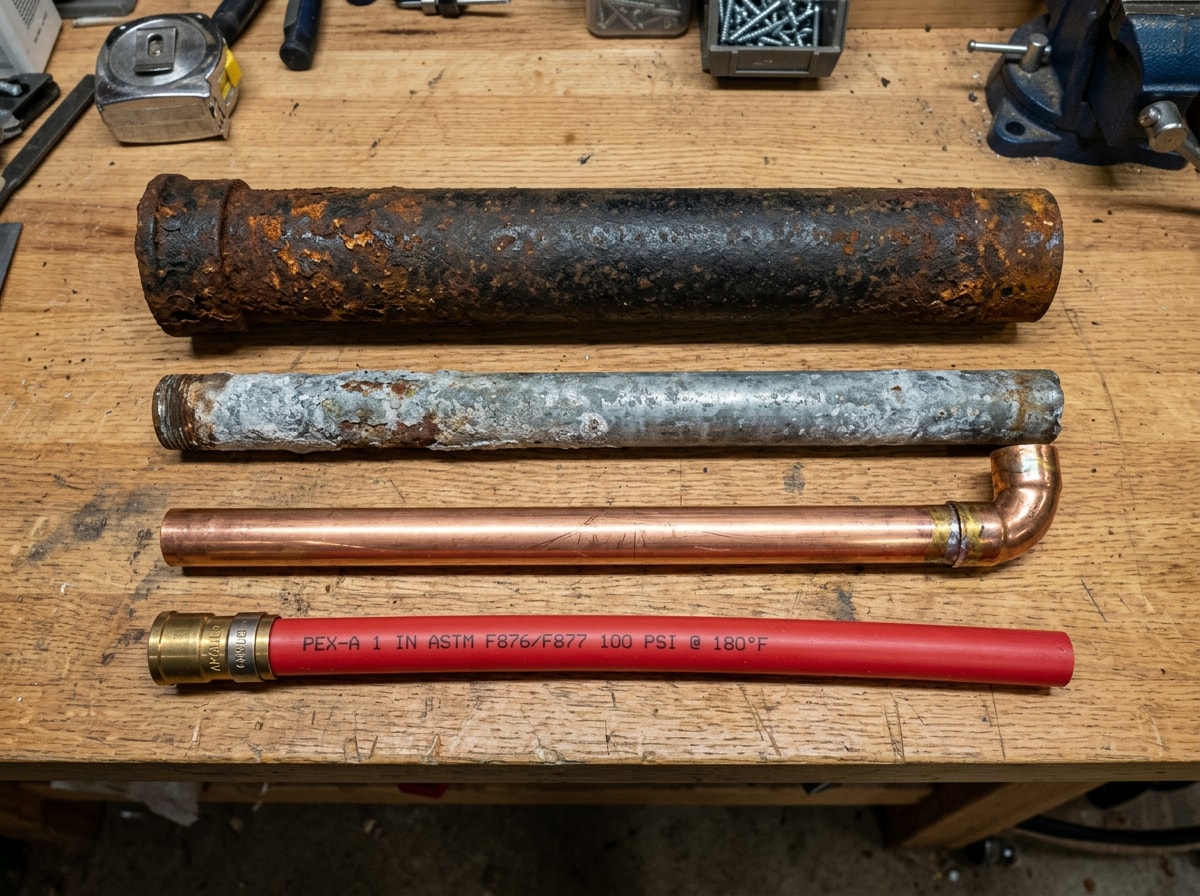
If your house predates that build-out, the age shows up in the pipe. In pre-1930 homes around Westfield and Morristown, we still open walls on galvanized steel supply lines, cast iron stacks and lead-wiped drum traps that were state of the art when they went in. Those systems can be nursed along, but pipe repair and replacement is usually the cheaper end of the math once the galvanized starts closing up with scale.
Planning a project on an older house? Get a free estimate before you open a single wall.
Plumbing Materials and Fixtures Through the Years
Pipe material tracks the whole timeline: clay, then lead, then bored wooden log, then cast iron, then galvanized steel, then copper after World War II.
Wartime metal restrictions in the 1940s and tight copper supply in the decades after pushed plastics into homes, first PVC and CPVC, later PEX.
Fixtures modernized alongside the pipe:
- Edwin Ruud built the first automatic gas storage water heater in 1889, the ancestor of every tank in a basement today.
- Vitreous china replaced wood-encased toilet cabinets.
- Alfred Moen's single-handle mixing faucet, designed in the late 1930s, reached the market in the late 1940s.
That line runs straight into current work like tankless water heater installation and water filtration systems.
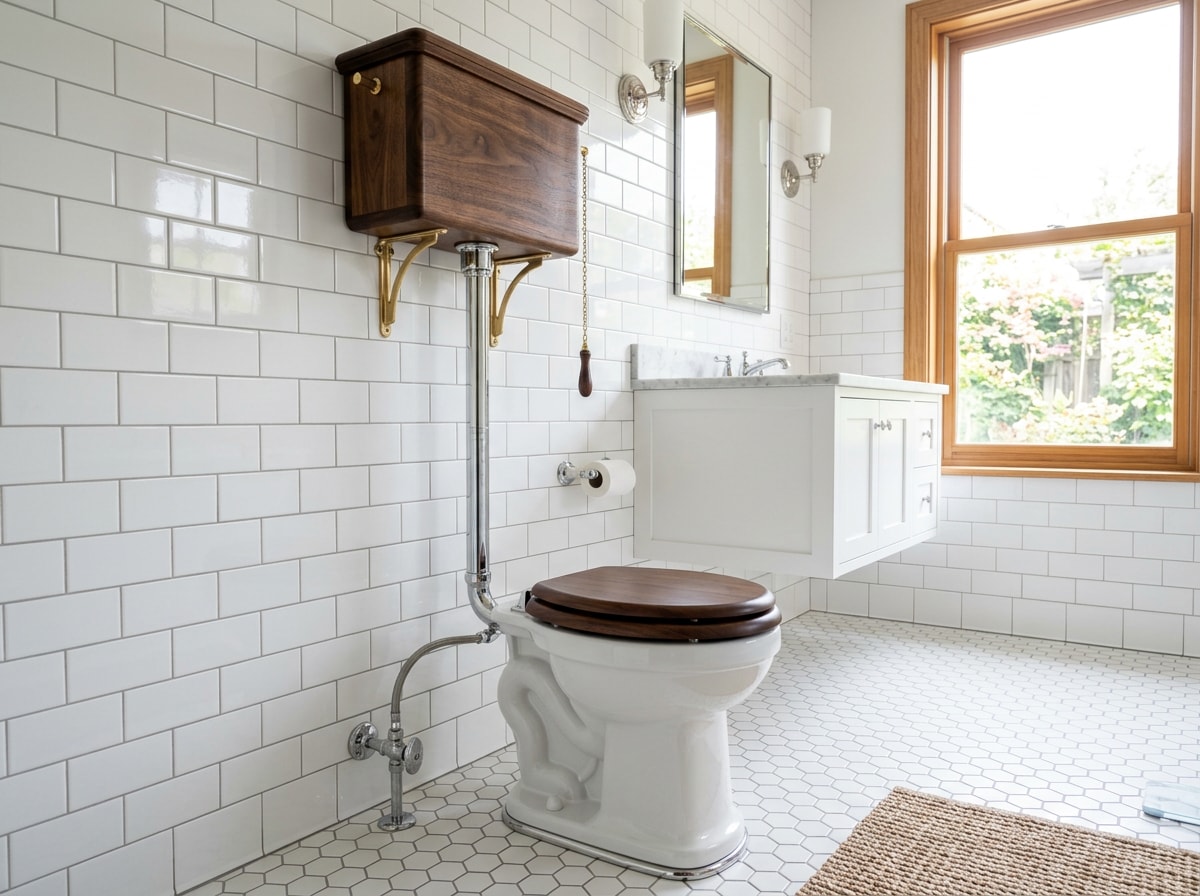
Efficiency rules closed the loop. Federal law capped toilets at 1.6 gallons per flush in the 1990s, and EPA's WaterSense program now labels toilets at 1.28 gallons per flush, which is 20 percent below the federal standard . You can compare labeled models on the EPA WaterSense residential toilets page before you buy.
Swapping a 6-gallon relic for a labeled model is the single easiest water win in an old house, and it pairs naturally with toilet repair and installation or a full bathroom remodel.
FAQ
When was indoor plumbing invented?
The earliest indoor plumbing dates to roughly 3000 to 2500 BC in Egypt and Mesopotamia, where clay and copper pipes served palace and tomb bathrooms. Plumbing that looks modern, meaning sealed traps, piped supply and a municipal sewer connection, took shape across the 1700s and 1800s.
Who invented indoor plumbing?
No one person. Harington built an early water closet in 1596, Cummings patented the S-trap in 1775, and Crapper commercialized the flush toilet in the late 1800s. Each solved one piece.
When did indoor plumbing become common in homes?
Census data shows nearly half of U.S. homes still lacked complete plumbing in 1940, about one-third in 1950 and one-sixth in 1960 . Most homes had it by the 1960s, and it was close to universal by 1990.
When did indoor plumbing come to the United States?
The first American hotel installation was Boston's Tremont Hotel in 1829, and the White House got running water in 1833. City-scale systems followed with Philadelphia's cast-iron mains and New York's Croton Aqueduct in 1842.
What did people do before indoor plumbing?
They carried water from a well, cistern, pump or street hydrant, heated it on a stove, and bathed in a portable tub. Waste went to an outhouse, a privy vault or a chamber pot emptied outdoors.
Did homes in the 1920s have indoor plumbing?
Many urban homes did, especially newer construction on city water and sewer. Rural and farm housing largely did not, which is why the 1940 count still found a huge share of homes with outdoor toilets.
When did toilets become standard in homes?
Indoor toilets became standard in American cities between the late 1800s and the early 1900s, once sewers gave fixtures somewhere to drain. Rural households lagged well into the mid-1900s.
When were showers invented?
Mechanical showers appeared in the late 1700s, and William Feetham is commonly credited with patenting one in 1767. Showers only became common household fixtures after pressurized city water and modern water heaters arrived.
Do any U.S. homes still lack complete plumbing?
A small share do. By the 1990 census, about 1 percent of homes lacked complete plumbing facilities , concentrated in the most rural and remote areas.
Working on a House With History
Plumbing took 5,000 years to arrive and about 50 years to become invisible. Old New Jersey housing stock still carries the evidence in its pipe, and that pipe eventually needs attention.
Aumenta Plumbing is a licensed New Jersey plumbing and heating contractor serving Mountainside and the surrounding towns, and our techs work on everything from 1920s cast iron to new PEX manifolds. Learn more about our service area and company or contact our team for a free estimate on leak, drain or pipe work. Have an active drip right now? Start with leak repair.